The Roman emissary of 398 BC — 2,400 years of engineering.
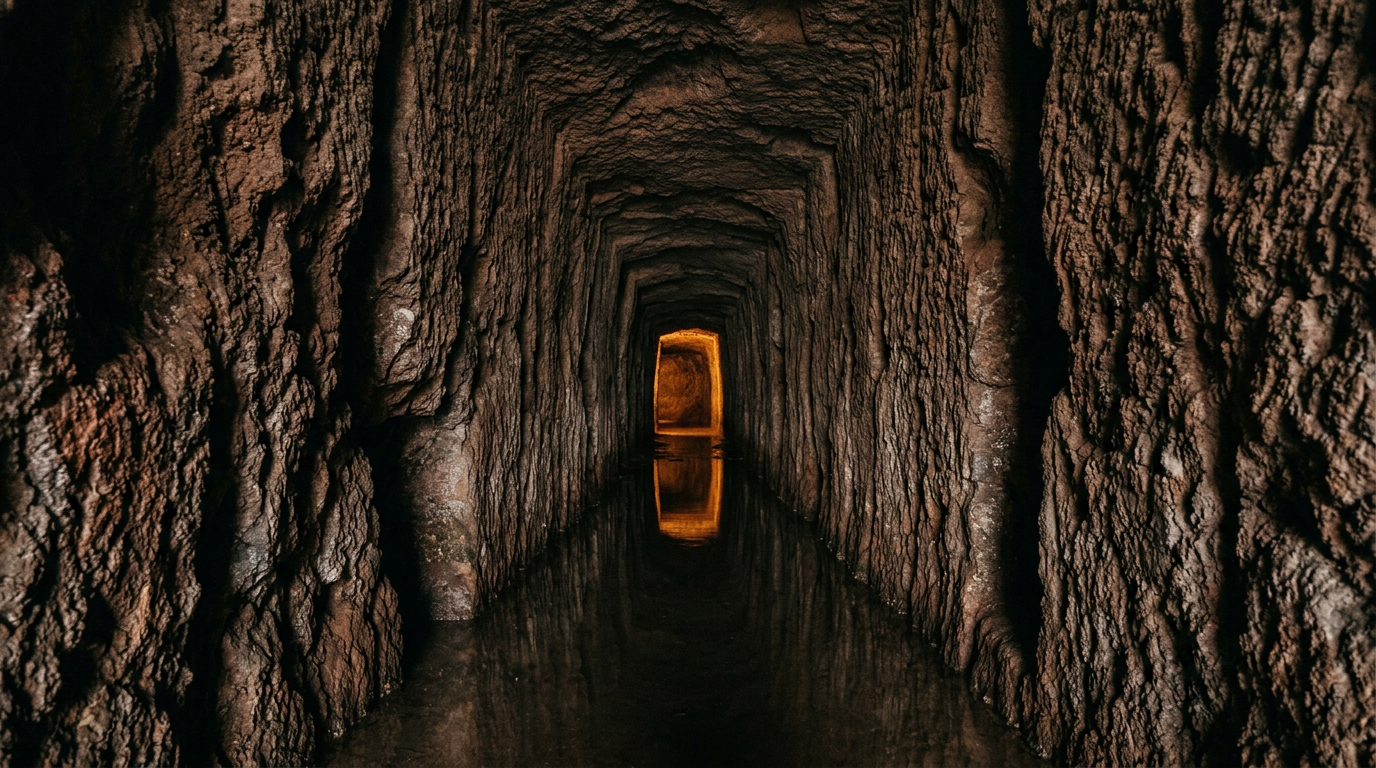
A tunnel cut into volcanic tuff, just over one metre wide and two metres high, running from Lake Albano beneath the crater wall and emerging on the other side, at the Le Mole locality below Castel Gandolfo. It is about 1,450 metres long, with a gradient of 0.14 per thousand, and it still works. The remarkable thing is that it was dug at the end of the 4th century BC, by hand, without explosives or machinery.
The Oracle of Delphi and Veii
The history of the Lake Albano emissary is intertwined with that of Rome. In 398 BC the lake's waters began to rise for no apparent reason — no unusual rainfall, no feeding rivers. Livy recounts the episode in book V of Ab Urbe condita: while the Romans were engaged in the long siege of the Etruscan city of Veii, the phenomenon was interpreted as a prodigy ([Wikipedia — Lake Albano](https://en.wikipedia.org/wiki/Lake_Albano)).
Consulted, the Oracle of Delphi was clear: Rome would defeat Veii only when the lake's waters were channelled and used to irrigate the fields ([Parchi Lazio — The Roman emissary](https://www.parchilazio.it/schede-594-l_emissary_romano)). Building the tunnel became, at once, a religious, political and hydraulic undertaking. According to tradition the whole work was completed in a single year, between 398 and 397 BC, with a workforce of some thirty thousand men ([Italia.it — Lake Albano](https://www.italia.it/it/lazio/roma/parco-dei-castelli-romani/lago-di-albano)).
The geometry of the tunnel
The measurements are known thanks to twentieth-century speleological surveys and to more recent work carried out by the Progetto Albanus. The tunnel is about 1,450 metres long, with an average width of 1.20 metres and a height of 2 metres, originally rectangular in section. It emerges at Le Mole, below Castel Gandolfo, after crossing the western wall of the crater ([Wikipedia — Lago Albano](https://it.wikipedia.org/wiki/Lago_Albano)).
The gradient is minimal but constant: about 0.14 per thousand. A carefully studied value, sufficient to guarantee gravity-driven flow without sediment accumulation. Five vertical shafts connected the surface to the tunnel, both for ventilation and for removing the material excavated during construction ([Lake Albano — Wikipedia](https://en.wikipedia.org/wiki/Lake_Albano)). The manoeuvring chamber at the intake, built in ashlar peperino masonry, is preserved to a height of more than five metres; it was restored in Sullan times, at the beginning of the 1st century BC.
How a tunnel like this was dug
The method was that of the cuniculi, a hydraulic technique developed in ancient Lazio probably with Etruscan and Greek contributions ([Progetto Albanus — Hypogea](https://speleology.wordpress.com/attivita-2/emissario-del-lago-albano-progetto-albanus/)). Vertical shafts were opened along the planned route; from each shaft two teams of workers dug horizontally in opposite directions, meeting halfway. The project required surveyors capable of transmitting alignment and level underground with millimetric precision: any deviation would have compromised the flow.
The working tools were pickaxe and hammer; the excavated material was raised to the surface with baskets and winches. The volcanic tuff of the Alban Hills is soft when freshly extracted and hardens on contact with air: a condition that made progress possible while ensuring the structural stability of the tunnel once completed.
Before the Cloaca Maxima
Historical tradition places the Albano emissary among the oldest documented Roman tunnel works, second only to the Cloaca Maxima ([Progetto Albanus — Hypogea](https://speleology.wordpress.com/attivita-2/emissario-del-lago-albano-progetto-albanus/)). The tunnel has been under state protection since the Ministerial Decree of 20 October 1909 and is today Italian cultural heritage. FAI has listed it among its Luoghi del Cuore ([FAI — Emissario Lago Albano](https://fondoambiente.it/luoghi/emissario-del-lago-albano)).
“Sine ullis caelestibus aquis causave qua alia, quae rem miraculo eximeret.”Livy, V, 15, 2 — the lake's waters rose with no rain or other cause to explain the prodigy
The 20th-century explorers
The emissary remained practically inaccessible until 1955, when the Roman Speleological Circle carried out the first modern exploration at the request of the Municipality of Albano, alarmed by a drop in flow. In the following decades further speleological attempts were made difficult by water, mud, collapses and calcite concretions reducing the section of the tunnel.
In 2013 Progetto Albanus began, coordinated by the Hypogea Federation. It is the first systematic multi-year study of the tunnel, conducted with speleological and speleo-underwater techniques and advanced documentation tools. A July 2023 article in Castelli Notizie reports that researchers have surveyed about 36 metres from the intake on via dei Pescatori and another 950 metres from the entrance at via delle Mole; about 400 central metres, obstructed by water and mud, remain unexplored ([Castelli Notizie](https://www.castellinotizie.it/2023/07/02/laffascinante-studio-dellemissario-del-lago-albano-1-420-metri-da-via-dei-pescatori-a-castel-gandolfo-ai-vasconi-di-albano/)).
Why it still works
The engineering reason is the same one that has held for two millennia: simple geometry, constant gradient, local materials. Tuff resists water erosion and needs no lining; the modest gradient prevents mechanical wear on the walls; the narrow section favours flow speed and reduces sedimentation. Modern mathematical models published by Idrotecnica Italiana have confirmed that the conduit is effective in containing the lake's level fluctuations even under severe weather events ([Idrotecnica Italiana](https://www.idrotecnicaitaliana.it/sommari/lantico-emissario-del-lago-di-albano-ipotesi-sulle-origini-ed-il-suo-ruolo-nel-tempo/)).
In the Middle Ages the water flowing out of the tunnel fed the watermills at Le Mole, from which the toponym. Even today the residual flow irrigates the farmland downstream: the Oracle's prophecy, in a sense, continues to be fulfilled.