Villa Barberini — the garden of terraces.
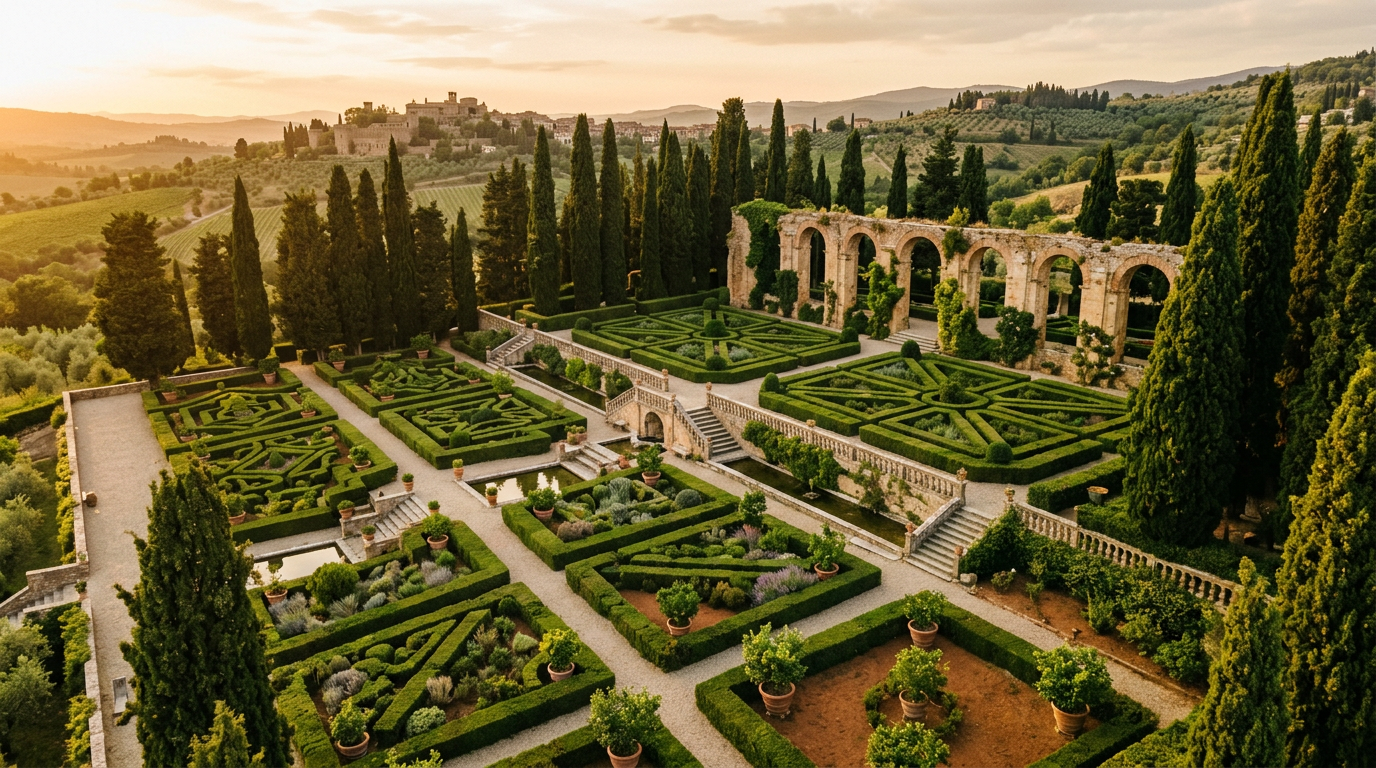
Under the flowered terraces of Villa Barberini runs a double layer of history: a Roman prince of the seventeenth century and an emperor of the first. Taddeo Barberini built his villa on the ruins of the Albanum Domitiani, and from that overlap came the masterpiece of the pontifical gardens.
The Albanum Domitiani, beneath the hedges
Before the popes and before the Barberini, this hillside belonged to Domitian. Between 81 and 96 AD the emperor built here an immense imperial villa, the Albanum Domitiani, extending over roughly 14 square kilometres, from the Appian Way down to and including Lake Albano ([Vatican State — Castel Gandolfo](https://www.vaticanstate.va/en/other-bodies/castel-gandolfo.html)). It included a private theatre, nymphaea, cryptoportici, lake-facing terraces and aqueducts. Whoever visits the Barberini Gardens today walks on the central terrace of the imperial residence.
Of the original 300-metre cryptoporticus, which served as the emperor's winter garden, about 120 metres survive and are still walkable ([Omnes — Borgo Laudato Si'](https://www.omnesmag.com/it/notizie/borgo-laudato-si-la-residenza-estiva-del-papa-e-il-sogno-di-prendersi-cura-del-creato/)). The remains of the imperial theatre, the retaining walls of the terraces and a few minor structures emerge among the hedges.
Taddeo Barberini, 1631
The modern villa was born of a family's ambition. In 1623 Maffeo Barberini had become pope as Urban VIII and had chosen Castel Gandolfo as the papal summer residence, entrusting the redesign of the Savelli castle to Carlo Maderno and then to Gian Lorenzo Bernini. His nephew Taddeo, made prince of Palestrina, wanted his own residence near his uncle's.
In 1628 Taddeo acquired the first plots; in 1631 he bought from the late Monsignor Scipione Visconti the villa in the Mompecchio locality, which contained the most notable remains of the Domitian villa ([Pontifical Villas — Palazzo Barberini](https://www.villepontificie.va/en/palace/villa-barberini), [Wikipedia — Villa of Domitian](https://en.wikipedia.org/wiki/Villa_of_Domitian)). By 1635 the complex could be called complete. Sources attribute the arrangement of the gardens to Bernini, who unified the ancient remains and the new palace into a sequence of terraces.
An Italian garden, in five terraces
Taddeo Barberini brought specialised workers from L'Aquila to clear the land and plant the garden ([Catholic Culture — Gardens of the Popes](https://www.catholicculture.org/culture/library/view.cfm?recnum=7926)). In the original layout, rustic zones were set aside for olive groves and an orchard, alongside areas with espaliers of laurel, cypress and holm oak, and geometric flower beds ([Pontifical Villas](https://www.villepontificie.va/en/palace/villa-barberini)).
The geometric design one admires today, with box hedges, avenues of holm oaks, flower parterres, fountains and statues, comes from later restorations, in particular the one completed after 1929 ([ViVi GREEN — Villa Barberini](https://www.vivigreen.eu/blog/villa-barberini-castel-gandolfo-roma/)). The oldest holm oaks are more than 400 years old. At the heart of the estate, the Belvedere deserves special mention: a monumental terrace with a panoramic view ([Vatican State — Castel Gandolfo](https://www.vaticanstate.va/en/other-bodies/castel-gandolfo.html)).
“Natural and archaeological settings of extraordinary charm.”Municipality of Albano Laziale — note on the Barberini Gardens
1929, 1989, 2016, 2025
Four dates tell the modern story of the villa. In 1929 the Lateran Treaty assigned to the Holy See the whole complex of the Pontifical Villas, recognised as an extraterritorial area of 55 hectares — larger than Vatican City itself ([Italia.it — Antiquarium of Villa Barberini](https://www.italia.it/en/lazio/castel-gandolfo/the-antiquarium-of-villa-barberini)).
On 26 October 1989 the Antiquarium was inaugurated: seven rooms on the ground floor of Villa Barberini displaying the finds from the Domitian villa ([Pontifical Villas — Antiquarium](https://www.villepontificie.va/fr/palais/villa-barberini/antiquarium)). In 2016 Pope Francis opened the whole complex to the public and transferred management to the Vatican Museums; the Apostolic Palace became a museum. In 2025, with the election of Pope Leo XIV, papal summers resumed here, but the pontiff chose to reside in Villa Barberini rather than in the Apostolic Palace ([Vatican News — Leo XIV in Castel Gandolfo](https://www.vaticannews.va/en/pope/news/2025-07/summer-papal-residence-castel-gandolfo-history-art.html)).
Visiting: gardens, Antiquarium, telescopes
Visits to the Barberini Gardens are booked exclusively online through the Vatican Museums. They run Monday to Saturday, subject to the calendar of the Pontifical Villas; entry times 8:30, 10:30 (Saturday only) and 11:30; duration roughly two hours, guided in Italian, English, French, Spanish and German ([Vatican Museums — Garden and Antiquarium visit (PDF)](https://www.museivaticani.va/content/dam/museivaticani/pdf/visita_musei/scegli_visita/ville/Visita_singoli_giardino_antiquarium_en.pdf)). Inside Villa Barberini are also two Zeiss telescopes of the Vatican Observatory dating to 1935 ([Rome Private Guides — Villa Barberini](https://romeprivateguides.com/a-guide-to-the-villa-barberini-gardens/)).
Those who have already seen the Vatican Museums are prepared for luxury. Those who arrive here find another scale: 55 hectares of silence, aligned cypresses, a view over the lake that no postcard captures and, everywhere, the sensation of walking in a double time — on the retaining walls of an emperor and in the garden of a prince. It is the masterpiece of the pontifical gardens, and for a year now it has once again been home to a pope.