The lake that does not die.
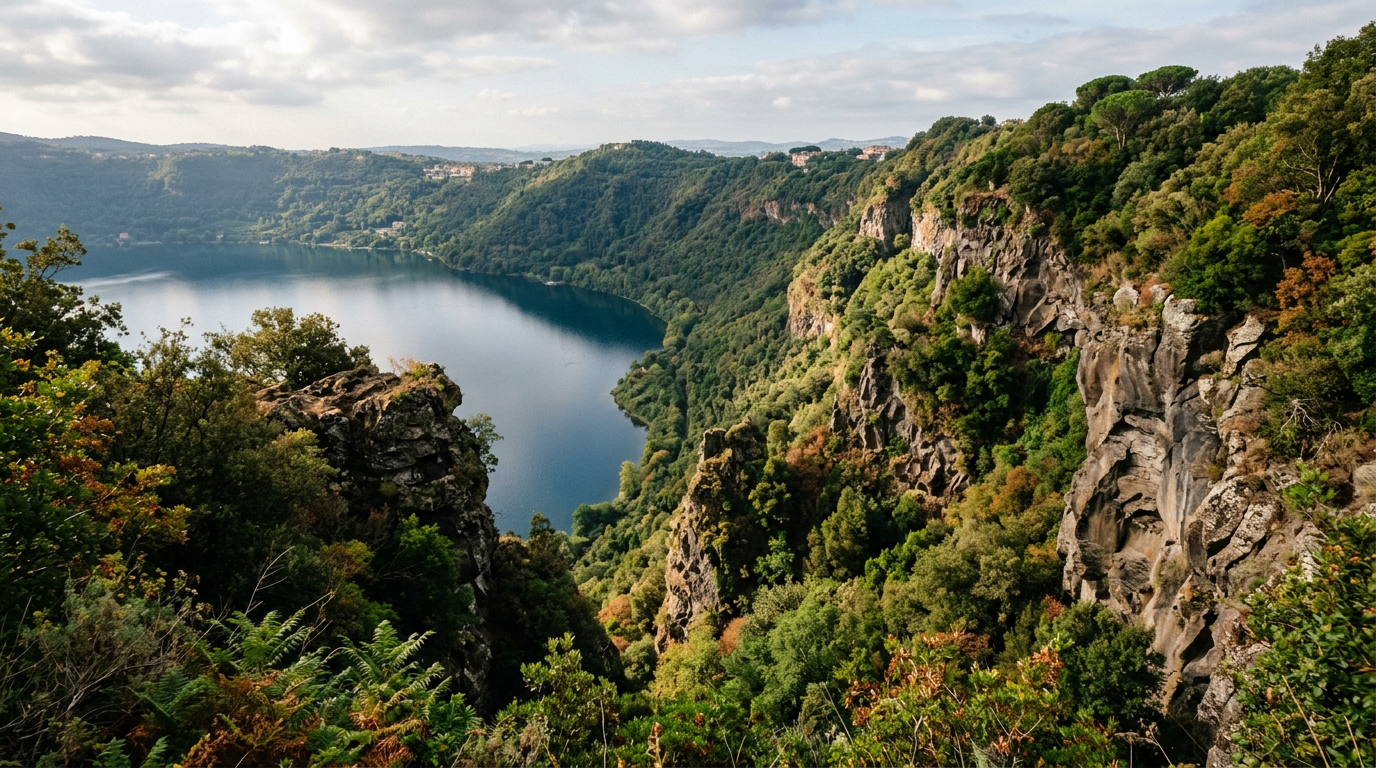
One hundred and sixty-eight metres below the surface of Lake Albano there are no fish, no light, no oxygen. There is only a geological memory. The memory of the last breath of a volcano that, perhaps, is not entirely dead.
Geologists call it the Colli Albani volcanic complex. It is an enormous caldera, more than ten kilometres wide, whose last major eruption dates back some thirty-six thousand years. Since then it has entered a phase of quiescence. But quiescence does not mean extinction. And Lake Albano, whose one hundred and sixty-eight metres make it the deepest in Lazio, is the window through which the volcano keeps watching the world.
How a crater lake is born
The almost perfectly circular shape of Lake Albano is no accident. It is the result of the union of two volcanic craters — explosive vents that opened side by side and which, filling with rain and spring water, formed a single sheet of water of about six square kilometres.
The lake has no significant inflows and no natural outlet. It is a closed basin fed by rainfall and groundwater. That is why, historically, its level tended to rise, threatening the surrounding land. Hence the oldest and most extraordinary human intervention in all of Roman hydraulic engineering: the artificial outlet.
The outlet tunnel of 398 BC
In 398 BC, during the siege of Veii, the Romans dug an underground tunnel almost two and a half kilometres long to lower the level of the lake. Legend has it that the oracle of Delphi had prophesied that Rome would conquer Veii only after taming the waters of Lake Albano. History or myth, the tunnel was indeed dug, and it still works perfectly twenty-four centuries later.
The tunnel is about a metre and a half high and just over a metre wide, cut into the tuff. It crosses the caldera on a gentle gradient and emerges in the countryside near Ariccia. It is one of the best-preserved works of hydraulic engineering of antiquity.
“Twenty-four centuries later, the tunnel dug by Roman slaves and engineers still regulates the waters of the lake. It is a work no one has ever dared to tamper with.”INGV · Vesuvius Observatory
Degassing and the risks
Beneath the lake, the caldera is still alive. Small emissions of carbon dioxide rise from the bottom. In 1989 a study by the National Institute of Geophysics and Volcanology found that, if accumulated in stagnant conditions, CO2 could reach dangerous concentrations — a phenomenon known as a "limnic eruption", the same that killed 1,700 people at Lake Nyos in Cameroon in 1986.
The risk for Lake Albano is considered low: its waters are well mixed, summer thermal winds encourage vertical exchange, and INGV monitoring is continuous. But the very existence of that monitoring tells a simple truth: the volcano is not dead. It is only waiting.
Living above a volcano
Castel Gandolfo, like Ariccia, Genzano, Nemi and Marino, stands on the flank of the caldera. The tuff from which the town walls are built is the same rock the volcano erupted thousands of years ago. Frascati wine, so mineral, draws its savour from soils rich in potassium and ash. The peaches of Castel Gandolfo owe their sweetness to the unique combination of volcanic soils and lakeside microclimate.
The volcano is not a sleeping monster. It is the element that shaped everything: the landscape, the economy, the cooking, the very identity of the Castelli Romani. Lake Albano is not a lake. It is a volcano looking at its own reflection.