Domitian's cryptoporticus — three hundred metres under the palace.
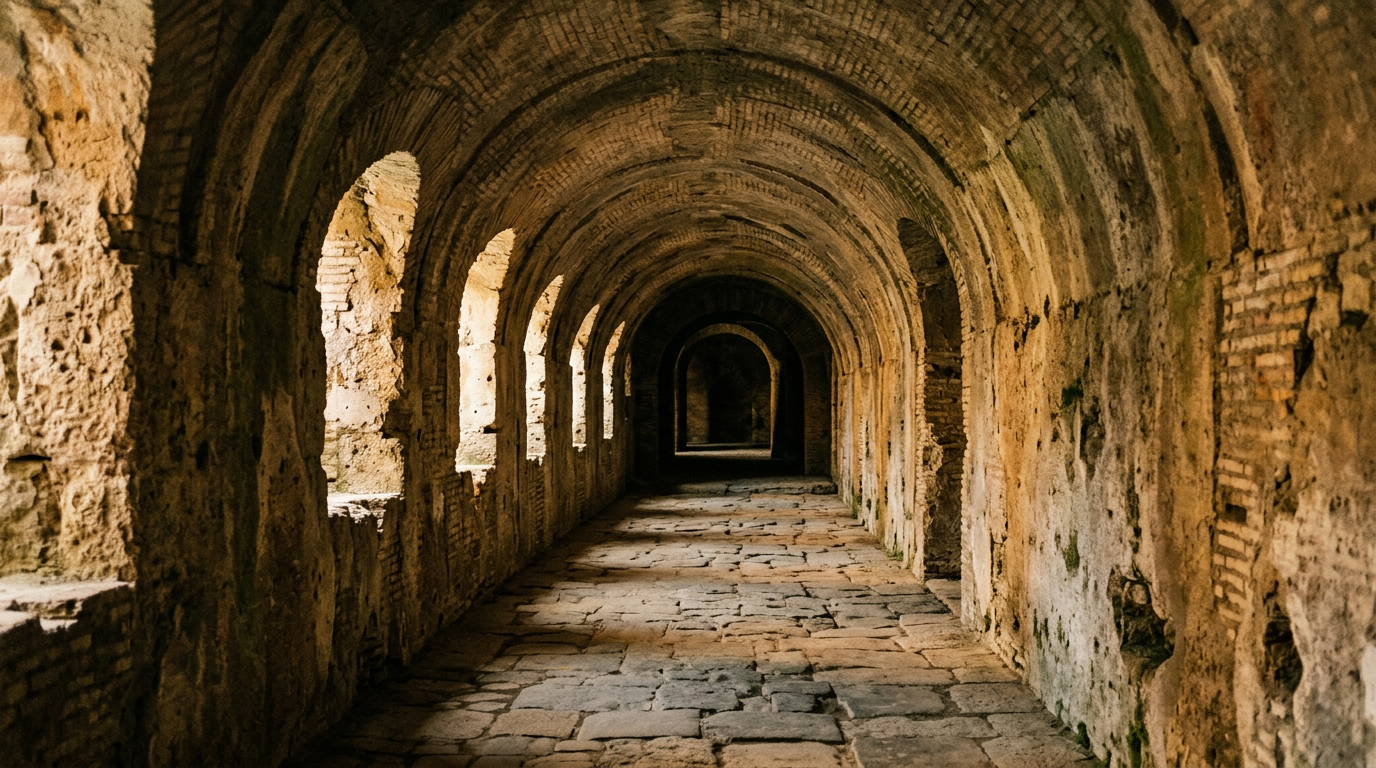
When you walk through the gardens of Villa Barberini, three hundred metres of tunnel run beneath your feet. It was carved two thousand years ago so an emperor could walk without being seen and without sweating. It is called a cryptoporticus, and it still supports the palace where the Popes lived for four centuries.
The word comes from Greek: kryptos, hidden, and portikos, covered walkway. In imperial Roman architecture, a cryptoporticus was an underground corridor with a barrel vault, closed on one side by the hillside and opened on the other by a row of small high windows called lucifera. It served two purposes: walking in the cool during summer, and walking sheltered during winter. In Domitian's case, it served a third: walking unseen.
The emperor Domitian (81-96 AD) was a man of growing paranoia. The poet Juvenal nicknamed him the bald Nero, and Suetonius reports that in his final years he had the walls of his bedroom lined with slabs of Parian marble, so that anyone approaching would be reflected as in a mirror. Castel Gandolfo's cryptoporticus, carved between 81 and 96 AD on the lower terrace of the Albanum Domitiani, must be read in this light: not merely a comfort, but also a defence.
How it is built
The tunnel is about four metres wide, five metres high, and runs in a straight line for approximately three hundred metres along the slope facing the lake. The roof is a barrel vault in opus caementicium, Roman concrete of lime mortar, tuff and travertine fragments. The walls alternate stretches of opus reticulatum, with small tuff blocks arranged in a chequerboard pattern, and stretches of opus mixtum, with brick courses at regular intervals. Every few metres, a rectangular window two metres tall opened westward, toward the lake: light and breeze came in, but the occupants remained invisible from outside.
“Domitian had the walls of his bedroom lined with slabs of marble so that anyone approaching would be reflected as in a mirror.”Suetonius, Life of Domitian, 14
Why it is still there
Domitian's villa did not last long as an imperial residence. Hadrian passed through briefly while his Tivoli residence was being completed; Marcus Aurelius took refuge here during the revolt of 175; under Septimius Severus the complex hosted the castra of his Parthian legionaries. Then came decline: the marbles were systematically stripped for Albano and, in the fourteenth century, for the construction of Orvieto Cathedral. But the cryptoporticus survived, because it was buried. Its very underground nature protected it from stone plunder.
When Taddeo Barberini, nephew of Urban VIII, bought the land in 1631 to build Villa Barberini, the site's masons found the tunnel and understood its value. The cryptoporticus was integrated into the villa without alteration. Today it runs parallel to the formal garden of the upper terrace, and in some sections is open for guided visits with the [Vatican Museums](https://www.museivaticani.va/).
How to visit
Access to the cryptoporticus is not included in the standard Papal Villas ticket. You need to book a specific archaeological guided visit, which also includes the Bergantino nymphaeum and the remains of the imperial theatre. The tour lasts about ninety minutes, is offered only with a licensed Vatican State guide, and is not available during papal residence periods.
Those who walk it are usually struck by two things. First: the silence. The tunnel lies five metres below the garden level, and the park's sounds arrive muffled, as if through cotton wool. Second: the air. After two thousand years, the cryptoporticus still maintains a constant interior temperature of around fifteen degrees Celsius, winter and summer. That is Domitian's climate engineering, still working twenty-one centuries after commissioning.